
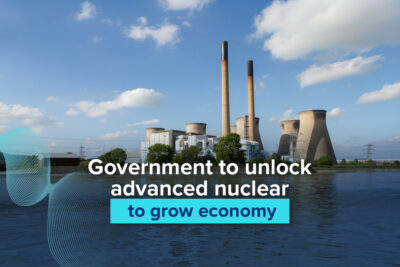
 The UK Government has this week set out its plans to accelerate the deployment of ‘advanced nuclear,’ including small, advanced, and micro-modular reactors, through its new Advanced Nuclear Framework.
This is designed to stimulate private investment and create a clearer route to delivery. In the context of rising demand for electricity – not least from the energy-intensive deployment of data centres – this is a significant signal of intent, and one which should translate into a substantial pipeline of work for CECA members as long as delivery is matched by streamlined procurement, planning, and grid connection.
At the core of the announcement is the creation of a government-managed pipeline of projects that meet specific readiness criteria, with a ‘concierge-style’ service to speed up planning and regulation, and to help developers meet fuel requirements.
Developers will be able to submit proposals to join the pipeline from next month, with assessments undertaken by Great British Energy – Nuclear and industry experts.
Successful projects may receive an in-principle endorsement, which could enable developers to enter discussions on potential support mechanisms for delivery, risk, and operation.
Commenting, CECA Director of Policy and Public Affairs Ben Goodwin said: “For CECA members, the key point is that ‘modular’ does not mean ‘minimal civils.’ Even factory-fabricated reactors still require major enabling works and supporting infrastructure, including site preparation, earthworks, drainage and flood resilience, heavy foundations, roads and logistics, utilities and cooling systems, and – critically – connections to end users.
“If advanced nuclear is to support industrial clusters, data centres, and economic growth at pace, these interface points – transport, utilities, water, and supporting infrastructure – become as decisive to the success of a scheme as the reactor technology itself.
“Nuclear delivery is a whole-system endeavour, and the supporting industrial capacity, transport, and security requirements must be planned early and integrated into the programme delivery.”
The Government frames this announcement as part of a wider ‘golden age’ of nuclear, referencing recent decisions on Sizewell C and the intention for SMRs at Wylfa on Anglesey, both of which CECA has championed (see here and here).
The Advanced Nuclear Framework is therefore best read not as a standalone policy document, but as an attempt to make privately-led projects investable alongside government-backed new build schemes. CECA supports steps that increase long-term certainty in the UK’s clean-energy pipeline, because certainty is what unlocks investment in people, plant, and productivity. But delivery will depend on whether the enabling environment matches the ambition. In particular:
- Procurement must reward whole-life value, not simply lowest headline price. Nuclear programmes succeed when buildability, sequencing and risk are addressed early, with transparent allocation of risk to the parties best able to manage it, and with realistic schedules that reflect regulatory and site constraints.
- Early market engagement and early contractor involvement should be the norm. If projects are to be delivered faster and more predictably, contractors need to be involved while designs and consents are still flexible.
- Planning and permitting need to be predictable, proportionate and properly resourced. Where sites are repurposed (for example, former energy or industrial assets), local infrastructure and community impacts need to be addressed upfront – including roads, workforce accommodation, and environmental mitigation.
- Grid connection and network upgrades must be treated as critical-path. Advanced nuclear aimed at industrial users and data centres will only deliver economic value if connections are timely and coordinated.
The Government notes that developers are targeting first AMRs operating by the mid-2030s. That timeline can work – but only if the UK now focuses on delivery mechanics: investable project structures, an integrated consenting pathway, and a procurement approach that drives productivity and safety while sustaining a resilient, high-performing civils supply chain.
CECA will continue to engage with Department for Energy Security and Net Zero, members, clients, and delivery bodies, to ensure the framework translates into projects on the ground – delivered safely, efficiently, and in a way that leaves a lasting skills legacy in communities across the UK.