
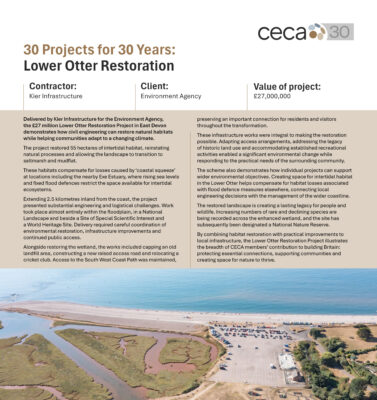
 As part of CECA’s 30th anniversary celebrations, our ‘30 Projects for 30 Years’ series highlights the contribution civil engineering makes to communities, the economy and the environment. Our latest profile features the £27 million Lower Otter Restoration Project in East Devon, delivered by Kier Infrastructure for the Environment Agency.
The project restored 55 hectares of intertidal habitat, reinstating natural processes and creating space for saltmarsh and mudflat to develop. These habitats help compensate for losses caused by ‘coastal squeeze’, where rising sea levels and fixed flood defences restrict the space available for intertidal ecosystems, including at the nearby Exe Estuary.
Extending 2.5 kilometres inland, the scheme required careful coordination of environmental restoration, infrastructure improvements and public access. Work took place almost entirely within the floodplain, in a National Landscape and beside a Site of Special Scientific Interest and a World Heritage Site.
Alongside restoring the wetland, Kier capped an old landfill area, constructed a new raised access road and relocated a cricket club. Access to the South West Coast Path was maintained throughout, preserving an important connection for residents and visitors.
The restored landscape is providing a lasting legacy for people and wildlife, with increasing numbers of rare and declining species recorded across the enhanced wetland. The site has subsequently been designated a National Nature Reserve.
Combining habitat restoration with practical improvements to local infrastructure, the Lower Otter Restoration Project demonstrates how civil engineering can help communities adapt to a changing climate while creating space for nature to thrive.