
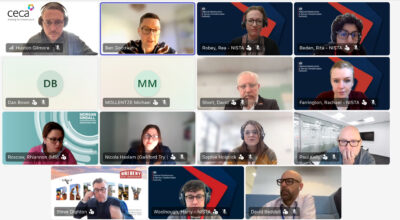
 CECA recently held a workshop session with the National Infrastructure and Service Transformation Authority (NISTA) and our members to explore the recently-published updated infrastructure pipeline. Ben Goodwin, Director of Policy and Public Affairs at CECA, reflects on the highlights.
The Infrastructure Pipeline seeks to provide industry and investors with up-to-date information on public and privately delivered infrastructure projects in construction, under development, or in pre-project stages where a clear strategic need has been prioritised by the UK Government or in business plans.
From a CECA perspective, it has the potential to help our members understand available work volumes coming down the track, enabling them to prepare and plan accordingly to win and deliver projects.
CECA arranged the workshop with NISTA to provide a platform for our members to highlight how the pipeline can best support these outcomes.
Specifically, the workshop focused on the following questions:
- How does the pipeline support different roles, and what are the most or least useful features? Are there any new aspects or insights in the latest iteration that have landed particularly well?
- How does the skills and workforce modelling support organisations?
- What developments should NISTA prioritise in future iterations? e.g. functionality or additional data and sectors that would add particular value?
At the start of the workshop NISTA officials set out some of the new features of the updated £718bn project pipeline, which since its launch on 9 March has received over 15,000 visits.
Some of the new features include workforce analysis for the next five years, a greater focus on supporting investment into projects and programmes, expanded data coverage and an overall emphasis on building confidence in the tool.
In terms of new data, the pipeline now covers projects being delivered by the Mayoral Combined Authorities (MCAs), alongside fresh input from the National Energy System Operator.
The workshop discussion was varied, but there was a clear view that since its inception the pipeline has improved considerably, from a spreadsheet with limited functionality to an interactive tool that provides a range of useful insights.
Focusing on continuous improvement, a great deal of the discussion considered how the pipeline could provide an enhanced understanding of the security of funding for projects and how close to market they are.
In turn, there were contributions around how the pipeline’s procurement and delivery functions might be improved, specifically in relation to capturing routes to market for different clients and linking into other government procurement portals. There were also suggestions made about the need to capture the new towns package announced by the Government earlier this week.
Other interventions included how government, working with industry, could improve the way in which the value of the pipeline is communicated, with the focus moving away from its monetary value to how it can practically support industry.
There were also reflections on extending the workforce analysis beyond five years to better recognise the timescales at play in the delivery of major infrastructure, and to capture future projects tied to the Government’s long-term infrastructure strategy.
CECA will continue to work with NISTA on the development of the pipeline and provide opportunities for our members to share their thoughts and insights.
If you would like to get involved, please get in touch at enquiries@ceca.co.uk.